

The Group+4
May 12, 2026OTB presents its 2025 Sustainability Report
The Group continues to implement its sustainability strategy with determination, recording significant progress on environment, materials and social impact
Together with the purchasing and product development departments and the style offices, OTB has developed the “OTB Raw Material Standards”.
These standards provide a detailed overview of the preferred raw materials and list materials that are banned or to be removed from the collections within specific timeframes. They also provide guidance on the main international certification schemes recognised by the Group for materials with a low environmental impact or those that guarantee animal welfare requirements.
The standards reflect OTB’s commitment to a more responsible fashion system, in line with the objectives of its Sustainability Strategy and the requirements of key markets and industry best practices.
In 2025, OTB began drawing up common guidelines, known as the OTB Responsible Product Guidelines, then finalised and circulated internally in 2025 through special training sessions. The guidance sets out specific criteria on the minimum content of low-impact materials that a garment must contain, as well as a list of treatments whose use is either preferred or restricted so that a product may be considered an improvement on its conventional version from an environmental or animal welfare perspective.
The brands of the OTB Group work to promote the use of lower-impact materials and processes, through the use of specific guidelines shared with the procurement and product development departments. These guidelines also consider the objectives of the Group Sustainability Strategy, the demands of the main markets and industry best practices. The aim is to expand the offer of responsible products, while guaranteeing quality standards and respecting the brands’ identity.
As a member of The Fashion Pact, OTB has continued to implement the activities aimed at ensuring that, by 2025, at least 25% of the main materials it uses at consolidated level have a lower climate impact. In 2025, sourcing of certified materials and materials that respect environmental and animal welfare standards rose significantly, to approximately 29% of total OTB Group purchases, exceeding the target set by The Fashion Pact.
Preferred lower impact materials on total OTB Group purchases, The Fashion Pact 25% target exceeded
Preferred cotton purchases compared to 2024
In 2025, OTB Group purchased a variety of raw materials, as illustrated in the chart below. Cotton accounted for the largest share, at 61%, followed by synthetic polymers at 24.7%. Leather makes up 6.8%, while artificial cellulosics and animal fibres account for 2.8% and 2.3% respectively.
Cotton
Synthetic polymers
Leather
Artificial cellulosics
Animal fibres
Other
Cotton represents the largest portion of the main raw materials purchased by the Group. For this reason, the OTB brands undertake to increase purchases of non-conventional types of cotton, such as organic cotton, recycled cotton, and cotton from regenerative agriculture.
In 2025, preferred cotton purchases increased by 39% compared to 2024
Conventional cotton
Preferred cotton
of which:
Organic cotton
Regenerative cotton
Recycled cotton
Since 2021, OTB Group has been a member of the Leather Working Group (LWG), a non-profit, multi-stakeholder organisation committed to reducing the environmental impact of leather production. The LWG standards establish environmental criteria against which leather manufacturers undergo independent and certified audits.
In 2025, OTB Group’s companies confirmed their commitment to cooperation with tanneries that are members of the Leather Working Group. During the reporting year, leather purchased from LWG-certified tanneries reached 43% of the Group’s total leather purchases, compared to about 31% in 2024.
The OTB brands continue to work for the development of a more responsible fashion system through continuous improvements in their offer of lower-impact products.
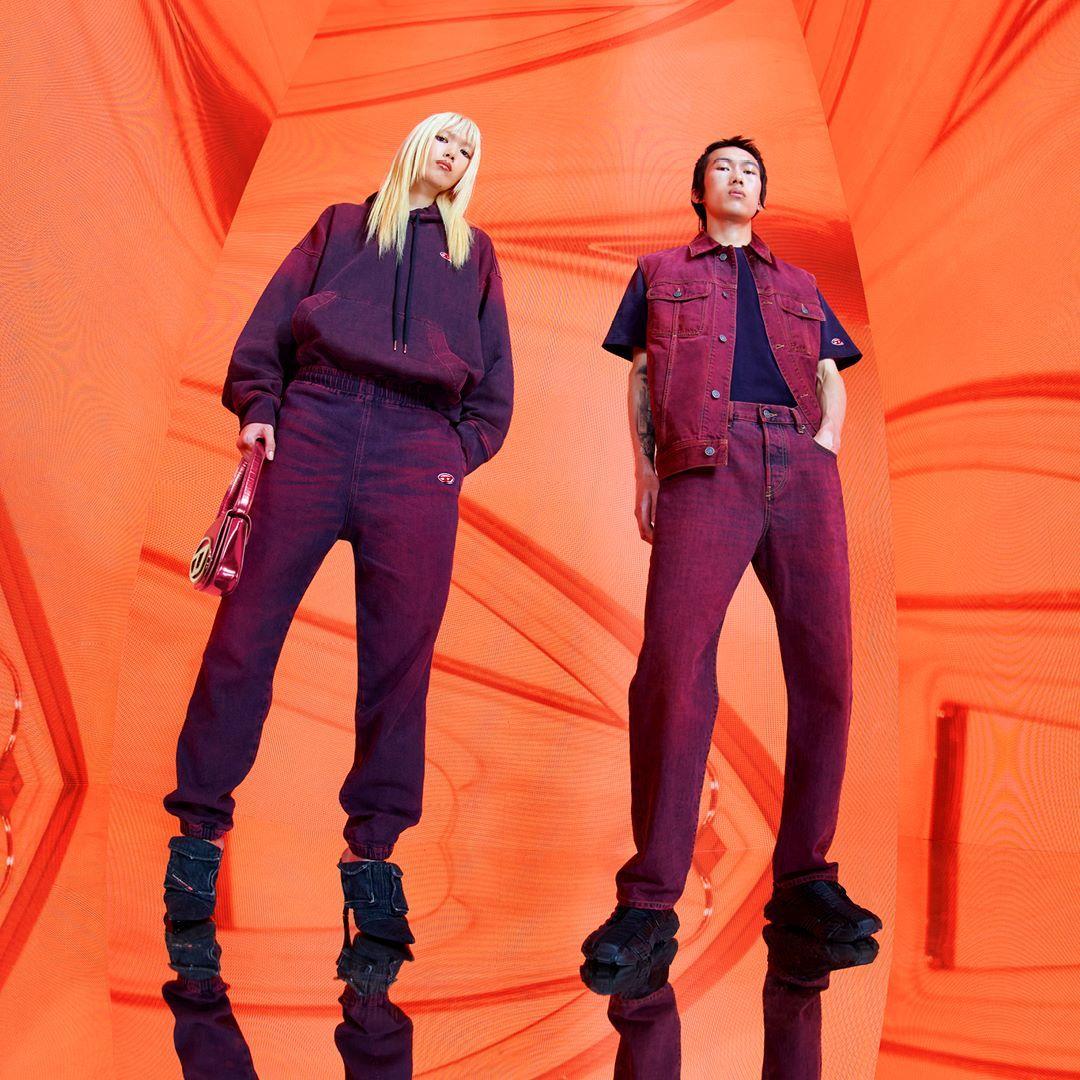
Among the various initiatives, Diesel achieved a significant milestone with its SS26 collection with more than 70% of the brand’s new Ready-To-Wear and Denim collections in line with the OTB Responsible Product Guidelines. For the same season, in the Denim category alone, 85% of the quantities produced for the new collection complied with those guidelines. The brand also increased its use of lower-impact cotton, which accounted for about 42% of its total cotton purchases, compared to 31.4% in 2024.
OTB Group production hub Staff International worked with the Marni, Maison Margiela and Jil Sander brands to help them improve their sustainability performance of their respective collections.
Within this context, Marni increased its use of certified low-impact fibres and innovative solutions. In the Pre SS26 collection, products compliant with the OTB Responsible Product Guidelines accounted for over 55% of total sales for the collection. In 2025, the brand further increased its use of lower-impact cotton, which accounted for around 35% of the brand’s total cotton purchases. Also, the proportion of leather purchased from LWG certified tanneries reached 66% of the brand’s total leather purchases.
Jil Sander has continued to gradually expand the use of alternative fibres and lower-impact materials in all its collections. In the SS26 Show collection, the total range of products compliant with the OTB Responsible Product Guidelines generated approximately 30% of sales, while products in the Bags and Small Leather Goods category accounted for 90%. In 2025, the brand continued to purchase alternative cellulose fibres from responsibly managed forests, reaching a share of approximately 27% in its Ready-To-Wear collections.
For Maison Margiela the main focus was leather. In fact, in 2025, leather purchased from LWG certified tanneries reached 55% of Maison Margiela’s total leather purchases. The Maison also focuses on research into innovative materials and processes with a low environmental impact. In the SS26 Show collection, products compliant with the OTB Responsible Product Guidelines generated more than 45% of sales, a figure that rises to over 85% in the Handbags and Small Leather Goods category alone.
In 2025, Brave Kid confirmed its commitment to sourcing materials with a low environmental impact for the collections of the brands it works for, reaching 19% in the SS26 collection, an increase of 7 percentage points compared with the FW25 collection.
Viktor&Rolf promotes the use of lower-impact materials and works with suppliers to identify innovative solutions that are consistent with the brand’s identity. In 2025, it introduced a new product category in the Ready-To-Wear collection featuring polymer-based alternatives to leather, choosing a cactus-based material that replicates the look and texture of leather and skins.
Promoting circular economy in the fashion system is pivotal to reduce the sector’s impact. At OTB, we are committed to promoting innovation and circular economy principles through pilot projects and initiatives, aimed at extending the products’ lifecycle, reflecting the DNA of each brand of the Group.
Our brands work to increase the use of recycled materials, the reuse of raw materials sourced from dead stock and warehouse remnants and to activate specific activities aimed at extending the products’ lifecycle, like post-sale garments’ repair and activities to incentivise their reuse.
To mention some key initiatives of our brands, in 2025 Diesel continued the project to reuse production off-cuts launched in 2022 in cooperation with the United Nations Industrial Development Organisation (UNIDO). The project creates a virtuous circle for fabric off-cuts to expand the management and recycling of denim scraps in the mechanical recycling process.
To contribute to the development of a circular fashion system, Diesel continued the Diesel Second Hand project in Italy, on the European e-commerce platform and in Japan, and launched DIESEL♥VES DIESEL Vintage, an initiative unveiled at the ComplexCon Festival in Las Vegas, where visitors were given the opportunity to purchase a selection of iconic Diesel garments from the 1980s and 1990s.
For its SS26 handbag collection, Marni designed and produced a cotton tote bag as part of its upcycling project, featuring a patchwork design created with archive fabrics.
Customer needs are key drivers of the OTB Group activities. For this reason, we aim at elevating the quality of our products and promoting services that make our customer experience unique. This is possible thanks to a transparent communication, aimed at promoting a cultural change
The Group continues to implement its sustainability strategy with determination, recording significant progress on environment, materials and social impact
Aura Blockchain Consortium announces the appointment of Stefano Rosso as its new Chairman
On the occasion of the celebrations for National Day of Made in Italy, OTB inaugurates the fifth edition of its School of Craftsmanship today. The Group’s in-house academy is a training programme designed to pass on to younger generations the artisanal and manufacturing expertise that defines Made in Italy fashion